
What Is a Smart Resistance Band? A Guide to Smarter Training

Home Based Rehabilitation in Europe 2026
February 10, 2026
Resistance bands are popular because they are portable, versatile, and suitable for many home and gym workouts. However, a traditional resistance band usually cannot show users how consistently they are moving or provide feedback during the exercise.
A smart resistance band adds a connected or wearable technology layer to this familiar training tool. Depending on its design, it may track aspects of movement, count repetitions, record sessions, or communicate feedback through an application, visual indicator, sound, or vibration.
This article explains what a smart resistance band is, how it differs from a traditional resistance band, what it may offer, and what users should consider before relying on smart training technology.
What Is a Smart Resistance Band?
A smart resistance band is a resistance-training tool that combines elastic resistance with sensing, connectivity, software, or digital feedback.
The physical band still provides resistance as it stretches. The “smart” element comes from the technology used alongside the exercise. Depending on the product, this technology may help collect or communicate information about:
- Exercise repetitions
- Movement patterns
- Training consistency
- Session history
- Progress over time
- General movement feedback
Not every smart resistance band includes the same capabilities. The term describes a developing category of connected training products rather than one standardized product design.
How Is a Smart Resistance Band Different from a Traditional Band?
The main difference is not necessarily the resistance itself. The difference is the information and feedback surrounding the exercise.
| Traditional Resistance Band | Smart Resistance Band |
|---|---|
| Provides elastic resistance | Combines resistance with connected or wearable technology |
| Usually does not record a session | May record repetitions, movement information, or training history |
| Feedback comes from the user or trainer | May provide app-based, visual, audio, or haptic feedback |
| Does not normally connect to software | May connect to a mobile application or digital platform |
| Simple and easy to use | Offers more information but also requires technology and interpretation |
A traditional resistance band can still be an effective and practical exercise tool. Adding technology does not automatically make an exercise better or guarantee correct movement. The value of a smart resistance band depends on the quality of its design, feedback, usability, and the way the information is interpreted.
What Types of Feedback May It Provide?
A smart resistance band may communicate feedback in several ways. The available features depend on the specific product and its intended use.
Repetition Feedback
A connected system may count repeated movements or record completed sets. This can make it easier for users to follow a structured session without counting every repetition manually.
Movement Feedback
Wearable technology may collect information related to general movement patterns or differences between repetitions. This information may help users become more aware of how they are performing an exercise.
Visual Feedback
A mobile application may display information such as completed repetitions, exercise progress, session summaries, or general movement indicators.
Audio or Haptic Feedback
Some products may use sounds or vibration to communicate information without requiring the user to look continuously at a screen.
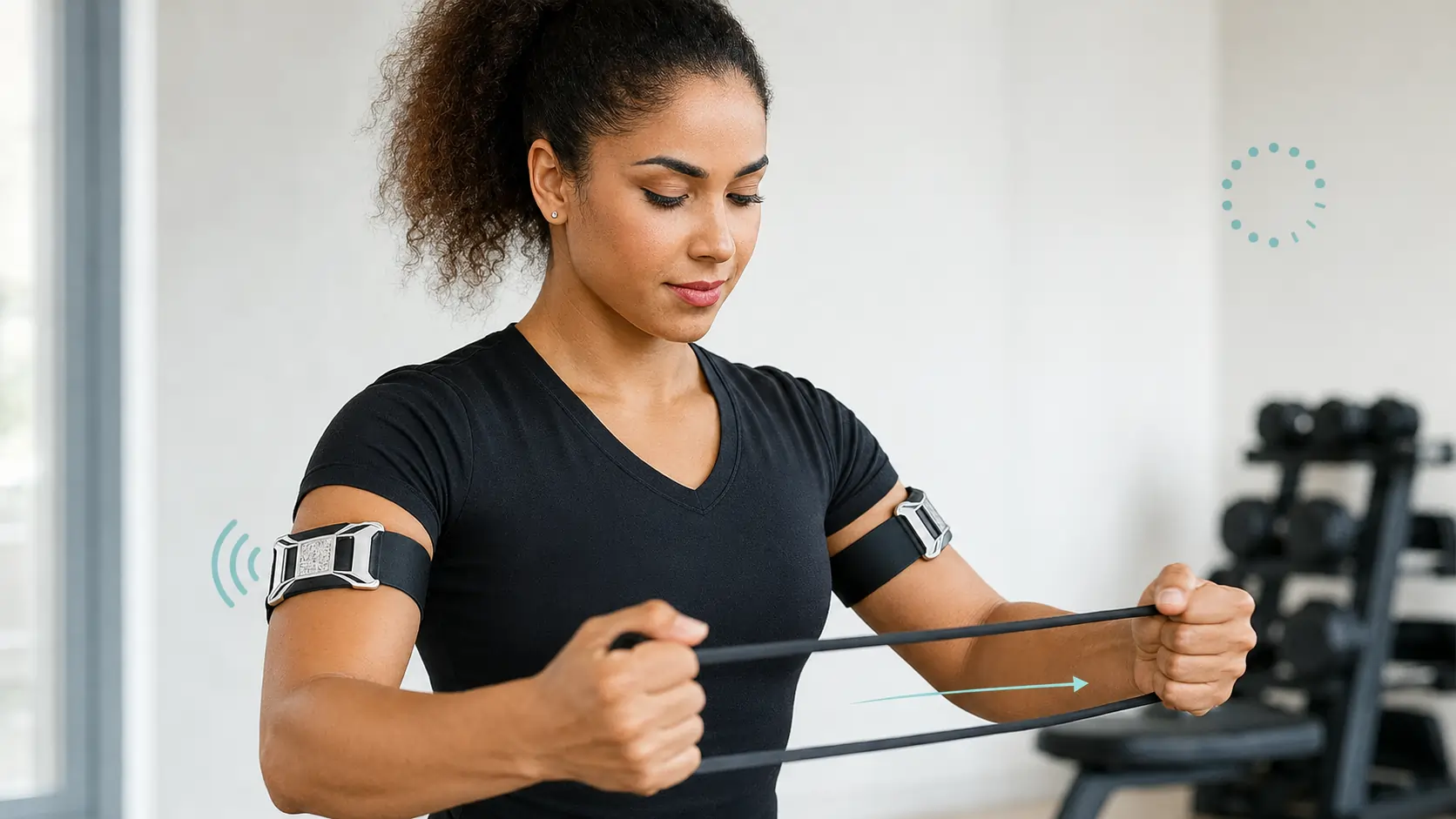
Smart training tools may communicate feedback through visual, audio, app-based, or haptic signals.
Why Does Feedback Matter During Independent Training?
Many people now exercise at home using videos, applications, and compact equipment. These tools improve access to exercise, but they do not always show users what is happening during the movement.
A user may complete the planned number of repetitions while still being unsure whether:
- The movement remained consistent
- Fatigue changed the exercise pattern
- One side moved differently from the other
- The exercise was performed as intended
- Training habits are improving over time
Feedback can help make the training experience more visible. It may encourage users to pay attention to movement quality rather than focusing only on repetition count.
Wearable technology remains highly relevant in the fitness industry. The American College of Sports Medicine ranked wearable technology as the leading worldwide fitness trend for 2026. ACSM also emphasizes that differences in device accuracy and user experience should be considered when these tools are used.
What Are the Limitations of Smart Resistance Bands?
Smart training technology can provide useful information, but it also has limitations.
Accuracy May Vary
Different products may use different approaches to collecting and interpreting information. Device position, exercise type, software quality, and user behavior may all affect the results.
More Data Does Not Always Mean Better Guidance
Information is useful only when the user understands what it means. A complicated dashboard may create confusion rather than support better training.
A Device Cannot Understand Every Situation
Wearable technology may not fully understand pain, personal medical history, confidence, fatigue, or the wider context of an exercise session.
Wearable Information Still Requires Responsible Interpretation
A 2026 World Health Organization report on measuring physical activity with wearable technologies highlighted the continuing need for clear metrics, device specifications, evaluation methods, and further research.
Research on AI and wearable technology in sport also suggests that practical value depends on data quality, validation, context, and professional expertise. These technologies are better viewed as decision-support tools than as autonomous authorities.
Can a Smart Resistance Band Replace a Trainer?
No. A smart resistance band may provide additional information, but it cannot replace the judgment, communication, experience, and personal understanding of a qualified trainer or movement professional.
A professional can consider factors that a wearable device may not fully capture, including individual goals, previous experience, discomfort, confidence, motivation, and the wider exercise environment.
The most useful role for smart fitness technology is to support people and professionals with clearer information, not to remove human guidance from the training process.
TopCycle’s Perspective
At TopCycle, we believe smarter training should help users understand their movement more clearly.
TopCycle is an early-stage Fitness-Tech and Health-Tech startup developing an AI-powered Smart Resistance Band designed to support smarter training through wearable movement feedback.
Our aim is not to replace trainers, physiotherapists, or other professionals. We are exploring how human-centered technology may support better movement awareness, personalized feedback, and more guided independent exercise.
TopCycle is building this direction step by step, with attention to usability, responsible communication, professional input, and the different requirements of fitness and future rehabilitation-related applications.
What Could the Future of Smart Resistance Training Look Like?
Smart resistance training may increasingly combine physical equipment, wearable sensing, mobile applications, and personalized feedback.
Future products may support:
- More interactive home workouts
- Clearer exercise records
- More personalized training experiences
- Better communication between users and professionals
- More accessible movement guidance
- Responsible future rehabilitation-support pathways
However, innovation must be balanced with accuracy, privacy, validation, usability, and appropriate professional involvement.
The most valuable smart training tools may not be those that display the most data. They may be the tools that turn relevant information into clear and practical guidance.
Frequently Asked Questions
What makes a resistance band smart?
A resistance band becomes smart when sensing, connectivity, software, or digital feedback is added to the physical resistance-training tool.
Can a smart resistance band correct exercise form?
It may provide information that supports movement awareness, but its capabilities depend on the product, its design, and its validation. It should not be assumed to identify or correct every movement mistake.
Can beginners use a smart resistance band?
Beginners may use smart resistance bands when the exercises, resistance level, instructions, and feedback are appropriate for their experience. Professional guidance may still be valuable, particularly when users are unfamiliar with resistance training.
Is a smart resistance band a medical device?
Not necessarily. Regulatory status depends on the product’s intended purpose, claims, design, and applicable legal requirements. A fitness product should not be presented as a medical device unless the relevant regulatory requirements have been completed.
Can a smart resistance band be used at home?
Many resistance bands are suitable for home exercise because they require limited space. Smart features may add workout records, guidance, or feedback, depending on the product.
Sources and Further Reading
- American College of Sports Medicine — The Future of Fitness: Top Trends for 2026
- World Health Organization — Measuring Physical Activity in Adults Using Wearable Technologies
- Frontiers in Artificial Intelligence — Artificial Intelligence and Wearables in Sport
Disclaimer: This article is provided for general educational purposes. It is not intended to replace professional exercise, medical, physiotherapy, diagnosis, treatment, or rehabilitation guidance.
Explore TopCycle’s approach to smarter training and wearable movement feedback.